Trump Claims U.S. Will Temporarily Govern Venezuela: What You Need to Know
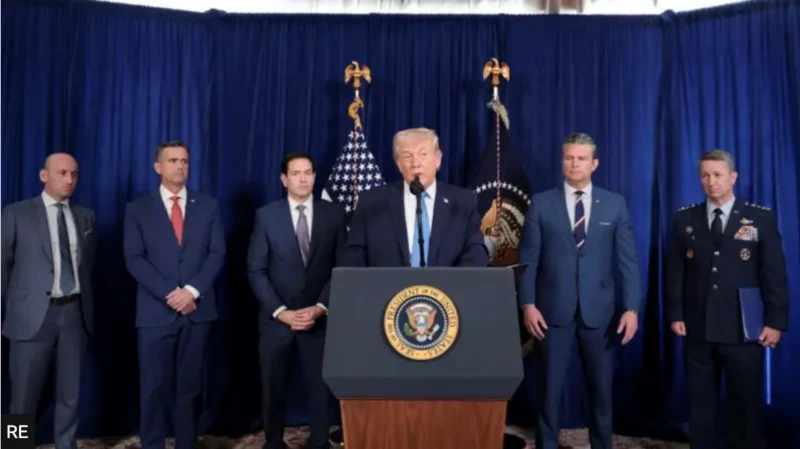
Donald Trump claims U.S. forces incapacitated Venezuela’s leadership and will temporarily govern the country after a military operation in Caracas, but no independent or official confirmation has been issued.
US President Donald Trump has declared that the United States will assume administrative control over Venezuela, claiming Washington will govern the country until a “safe, orderly, and wise transfer of power” can be achieved.
The statement marks a dramatic escalation in US involvement in Venezuela and follows Trump’s earlier claim that Venezuelan President Nicolás Maduro and his wife have been detained and transferred out of the country.
Trump said the operation was carried out by the US military, targeting Venezuela’s central leadership and military infrastructure. He stated that Nicolás Maduro and his wife are now facing what he described as “American justice,” including criminal charges filed in the Southern District of New York.
The Venezuelan armed forces and government institutions were described by Trump as having been rendered “fully incapacitated” during the operation, though no independent confirmation has been provided.
Trump made the remarks on Sunday, January 4, via public statements and social media posts. He claimed the decisive military action took place in central Caracas, including an assault on what he described as a “heavily fortified military compound” in the heart of the capital.
If accurate, the US assumption of control over Venezuela would constitute one of the most significant foreign interventions by Washington in decades and would raise serious questions under international law, particularly regarding sovereignty, occupation, and the prohibition on the use of force.
The declaration also risks triggering regional instability across Latin America, provoking diplomatic backlash, economic disruption, and potential armed resistance within Venezuela.
Trump said the United States would “run Venezuela” temporarily to facilitate a controlled political transition. He asserted that US forces successfully neutralised all Venezuelan military capabilities during the operation and claimed that Caracas experienced a complete power blackout due to what he called America’s “advanced technical capabilities.”
He compared the Venezuela operation to previous US military actions against Iran, including strikes on nuclear-related targets, stating: “There is no country in the world that can do what America has done and succeeded in doing.”
Trump further alleged that Maduro and his wife are facing charges linked to what he termed a “deadly narco-terror campaign” against the United States and its citizens.
US–Venezuela relations have been hostile for more than a decade. Washington has long accused Maduro’s government of authoritarian rule, election manipulation, corruption, and involvement in international drug trafficking. Maduro, in turn, has accused the United States of orchestrating economic warfare and attempting regime change through sanctions and covert operations.
Previous US administrations recognised opposition figures as Venezuela’s legitimate leadership, imposed sweeping financial and oil sanctions, and pursued indictments against senior Venezuelan officials. Trump’s latest statements appear to push that confrontation into unprecedented territory.
As of publication, there has been no official confirmation from the US Department of Defense, the State Department, or the US Congress supporting Trump’s claims. The Venezuelan government has not issued a formal response, and no international organisation or independent media outlet has verified assertions of a US military takeover, the detention of Maduro, or the collapse of Venezuelan armed forces.
Legal and security analysts warn that unilateral US governance over Venezuela—if carried out—would likely be classified as military occupation under international law, requiring clear legal justification, international oversight, and defined limits.
Observers also note that such an action could face resistance from regional powers, provoke asymmetric conflict, and deepen global divisions, particularly given Venezuela’s ties to Russia, China, and Iran.
Trump’s declaration that the United States will govern Venezuela represents an extraordinary claim with potentially historic consequences. However, in the absence of independent verification or institutional confirmation, the situation remains highly uncertain. What is undeniable is that the rhetoric alone signals a sharp intensification of US–Venezuela tensions, with implications that could reshape regional and global geopolitics if substantiated.