Somalia’s Gudmo-Biyo-Cas Forest Wealth: What You Need to Know
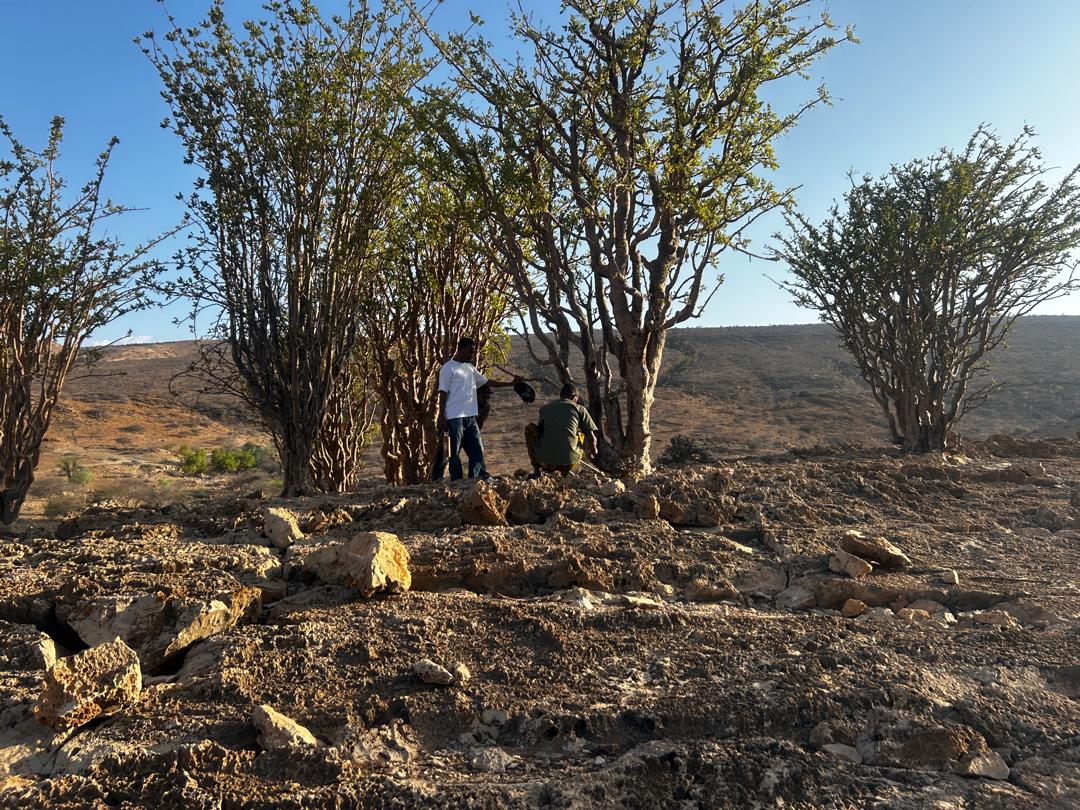
In Gudmo-Biyo-Cas, Somalia, valuable frankincense forests sustain local families, but market collapse and traditions denying women inheritance rights limit who benefits from this natural wealth.
In the western highlands of the Sanaag region in northern Somalia lies Gudmo-Biyo-Cas, a remote rural area known for its extraordinary forest resources. Towering across its rugged mountains are some of the world’s finest resin-producing trees: Beeyo/Moxor (Frankincense), Maydi (Boswellia sacra), Malmal (Myrrh), and Luubaan (Frankincense). These trees grow naturally, requiring no cultivation, and have sustained local families for generations, particularly through periods of drought and scarcity.
For residents, the trees are more than a source of income, they are a form of inherited wealth and survival. As Awil Salah Warsame explains:
“These trees are valuable and irreplaceable. They can be traded for livestock or other goods. They are our lasting wealth. We have survived for many years through droughts and scarcity thanks to them.”
Historically, resin from these forests formed the backbone of the local economy. In recent years, however, the collapse of the company that purchased the harvest has left locals without a formal market. Now, most sales are mediated by middlemen who transport the resin to major cities, providing minimal returns to the harvesters.
“Right now, our daily livelihood doesn’t change much. Whatever we harvest has no proper market. The trees are mostly sold to people who can take them to big cities, and we get very little benefit.”
Resin that once sold for around $5 per kilogram now fetches as little as $1.50, and prices are inconsistent. Only a few traders, with access to urban markets, manage to earn a reliable income.
Despite these challenges, the community enforces strict rules to protect the trees. Harvesting is regulated, and damaging a tree at the wrong time can result in fines or social penalties.
“These trees grow slowly and need care. Anyone who harms them at the wrong time has to pay fines or face penalties. No one can easily damage them. They are our heritage, and we protect them.” Jinow Haaji Yusuf explained:
Yet, as I learned during my visit, not all members of the community benefit equally. Women do not have direct rights or inheritance over these trees. Their role is largely limited to cleaning and preparing resin, earning only a small income.
“Men control these trees and don’t allow women to own or sell them. This has been the local tradition for as long as I can remember. Women are only allowed to do small tasks like cleaning.” Yusuf added.
Most women have grown up accepting this tradition, and little effort is made to challenge it. Speaking out, they say, risks social disapproval or personal pressure and I also was informed that abandoning tradition is widely regarded as an act that angers God, and it is considered shameful for girls to challenge these family customs, with the possibility of being cursed if they do.
For me, reporting on Gudmo-Biyo-Cas was a profoundly different experience. Over the years, I have covered wars, political conflicts, and even parliamentary disputes - as I witnessed MPs exchanging blows on the floor of parliament. Yet here, for the first time, I found myself reporting a story not defined by conflict or politics, but by tradition, survival, and resilience. I thoroughly enjoyed learning from the people of Gudmo-Biyo-Cas, their deep knowledge of the forests, the care they take in protecting them, and the subtleties of their social structures offered a perspective entirely new to me as a journalist.
Religious scholars point out that these traditions are inconsistent with Islamic law. Sheikh Ahmed Nuur Cabdi Jimcaale emphasised:
“This custom violates the rights that Islam gives women. It is important to adjust it so that women can have their fair share.”
Islam allows women to inherit property left by their parents, although shares may differ from those of men. In Gudmo-Biyo-Cas, however, women continue to have no rights to these trees.
Infrastructure adds another challenge. A 90-kilometre road now connects Gudmo-Biyo-Cas to the regional capital, Ceerigaabo, but the journey remains treacherous. Steep mountains and deep valleys limit access to markets, healthcare, and education, keeping the community relatively isolated despite its natural wealth.
By Naima Salah