The Unmuted Mic: How a Newsroom of Women is Rewriting Somalia's Story
Take the global 16 Days of Activism against Gender-Based Violence. Much of the world covers it through numbers and headlines. At Bilan, we go further. We ask: What does justice look like for a woman whose nearest court is days away? How does a “women empowerment” program fail when she cannot even travel safely to the market? Who are the unsung community leaders—women and men—quietly mediating disputes to prevent violence before it starts? These layers only emerge when the journalist understands the culture, the sensitivities, and the stakes.
When I first joined Bilan Media, there was a statistic that kept echoing in my mind—one I had come across long before I ever dreamed I would work inside an all-women newsroom. It was a global study on who gets quoted in the news. The conclusion was blunt: women are underrepresented almost everywhere. When women are included, they are often asked how they feel rather than what they know. In moments of crisis, they are the emotional footnotes. In stories of policy or power, they vanish altogether.
I thought about this often. But the reality of it hit differently the first time I stepped into the Bilan office.
Inside that room, the numbers flipped. The experts were the women seated around me—reporters, editors, producers—each one holding the kind of authority, skill, and lived experience that the world so rarely associates with Somali women. The sources they were calling were other women too… farmers, entrepreneurs, survivors, leaders, mothers. Suddenly, the statistic wasn’t just something I read. It was something I was watching being rewritten in real time.
And that’s when I realised: Bilan is not just Somalia’s first all-women media house. It is a quiet revolution. A slow but steady rebalancing of who gets to explain our world.
For decades, the world has viewed Somalia through a narrow lens—conflict, drought, piracy, political crisis. These issues are real; we report them with courage. But they are not the whole truth. When the storytellers come from only one slice of society, the country begins to look like a silhouette—missing depth, texture, and humanity. And so much of what is missing are the stories of women, the very people who hold families and communities together.
Where are the investigations into the women in IDP camps who run their own informal banks to survive?
Where are the climate stories featuring the women in Barawe whose livelihoods crumble with coastal erosion?
Where are the profiles of young female tech graduates in Hargeisa solving problems with code?
These aren’t “soft” stories. They are stories of resilience, innovation, and survival. They tell us not just who we are, but who we are becoming.
This is the silence Bilan breaks every day.
We don’t simply add women’s voices to old narratives—we reshape the narrative entirely. Because when a woman journalist interviews another woman, the angle changes. The understanding deepens. And the truth comes into focus in a way that is impossible to achieve from the outside.
Take the global 16 Days of Activism against Gender-Based Violence. Much of the world covers it through numbers and headlines. At Bilan, we go further. We ask:
What does justice look like for a woman whose nearest court is days away?
How does a “women empowerment” program fail when she cannot even travel safely to the market?
Who are the unsung community leaders—women and men—quietly mediating disputes to prevent violence before it starts?
These layers only emerge when the journalist understands the culture, the sensitivities, and the stakes.
Our work begins long before the microphone is switched on. Sometimes over tea. Sometimes over long conversations where trust is slowly built. Many of the women who speak to us have been ignored, sensationalized, or misunderstood before. So we listen first. Deeply. Patiently. This isn’t a compromise of journalism—it is the foundation of good journalism.
Of course, our path is not without challenges. People question our “objectivity,” as if a woman reporting on maternal health is somehow more biased than a man reporting on politics. We know that our mistakes are judged harshly, not just as our own failures, but as failures of all Somali women in media. And we carry the weight of societal expectations every single day.
But what balances that weight is the power of what happens after we publish.
When we profile a woman mechanic in Mogadishu, young girls comment, “I didn’t know we could do this.”
When we air a documentary on women farmers and climate change, ministries pay attention.
When our editorial team debates sensitive ethical choices, we are quietly modeling a new kind of leadership—collaborative, thoughtful, principled.
No single newsroom can fix a century of imbalance. But we can offer proof—living, breathing proof—that when women tell the story, the story changes. It becomes richer, fairer, more complete. It shifts from tragedy to resilience, from chaos to context, from a single fearful narrative to a mosaic of voices that finally reflect reality.
My revolution isn’t loud. It doesn’t take place in the streets.
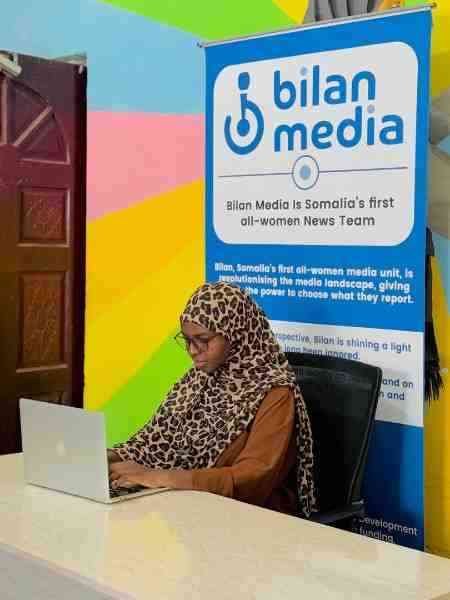
It lives in production schedules, in the soft clicking of keyboards, in the concentration on a reporter’s face as she transcribes an interview. It’s in the courage of a woman who shares her story for the first time. It’s in the gentle way our team holds the microphone—steady, open, and ready.
Every day at Bilan, we amplify voices that have been dimmed for too long.
Somalia is hearing itself fully—its pain, yes, but also its brilliance, its humour, its strength, its creativity.
And this is just the beginning.
We are not closing a chapter.
We are writing a new one—boldly, tenderly, and together.
By Amina Yusuf, Media Coordinator, Bilan Media