Mohamed Ibrahim: The First Kenyan Somali to Serve as a Supreme Court Judge
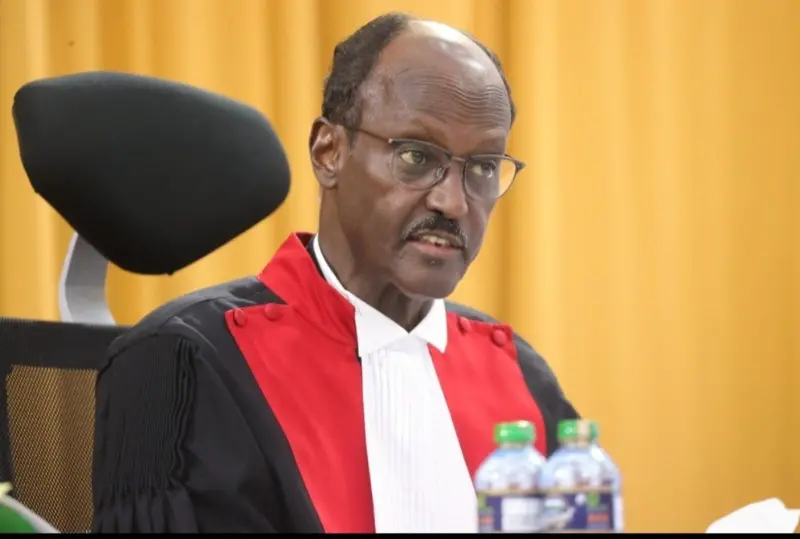
Justice Mohamed Ibrahim, the first Kenyan Somali Supreme Court judge, has died in Nairobi at 69. His 23-year judicial career advanced minority representation, human rights, and electoral justice in Kenya.
Justice Mohamed Khadar Ibrahim made history as the first Kenyan of Somali origin to rise to the country’s highest judicial office, leaving behind a legacy defined by legal excellence, courage, and an unwavering commitment to justice and democracy.
Justice Ibrahim was formally admitted as an Advocate of the High Court of Kenya on January 11, 1983, becoming one of the earliest members of the Kenyan Somali community to reach senior professional status in the legal field. At a time when representation of minorities in the judiciary was rare, his achievement marked a turning point for inclusion and recognition.
In 1994, he established his own private law firm, Mohammed Ibrahim & Co., which later expanded in 1997 and was rebranded as Ibrahim & Isaack Advocates. Through the firm, he built a reputation as a disciplined, principled, and highly respected lawyer.
Beyond private practice, Justice Ibrahim was also a founding member of Mwangaza Trust, a human rights organization known for its advocacy on social justice and the protection of marginalized communities. His work placed him among the most prominent voices calling for fairness, accountability, and the rule of law in Kenya.
That commitment came at a personal cost. In July 1990, during the authoritarian one-party era under President Daniel arap Moi, Justice Ibrahim was detained without trial for one month at Kamiti Prison. His detention was linked to his legal advice and support for pro-democracy activists, as well as his opposition to elements of the ruling political system at the time.
In later years, Justice Ibrahim played a critical institutional role by serving as a key link between the High Court and the Independent Electoral and Boundaries Commission, strengthening coordination between judicial and electoral bodies during sensitive national processes.
His judicial career spanned 23 years, during which he held several senior positions. Before his elevation to the Supreme Court of Kenya, he served with distinction at the Court of Appeal, earning respect for his legal reasoning and integrity.
Justice Ibrahim was part of the Supreme Court bench during the landmark 2017 presidential election petition filed by opposition leader Raila Odinga against then-President Uhuru Kenyatta. During the proceedings, he fell ill and was placed under medical care, a development formally communicated by then Chief Justice David Maraga. Despite his absence, the court proceeded in accordance with constitutional provisions requiring a minimum quorum of judges.
On Wednesday, December 17, 2025, Justice Mohamed Ibrahim passed away at Aga Khan Hospital in Nairobi at the age of 69, according to fellow judge Mohamed Warsame. Chief Justice Martha Koome led tributes, offering condolences to his family, colleagues, and the wider legal community.
Justice Mohamed Ibrahim’s life journey—from a pioneering advocate to a Supreme Court judge—stands as a powerful testament to perseverance, principle, and public service. For Kenya’s Somali community and the nation at large, his legacy endures as a reminder that justice, when pursued with courage and integrity, can reshape institutions and inspire generations.